
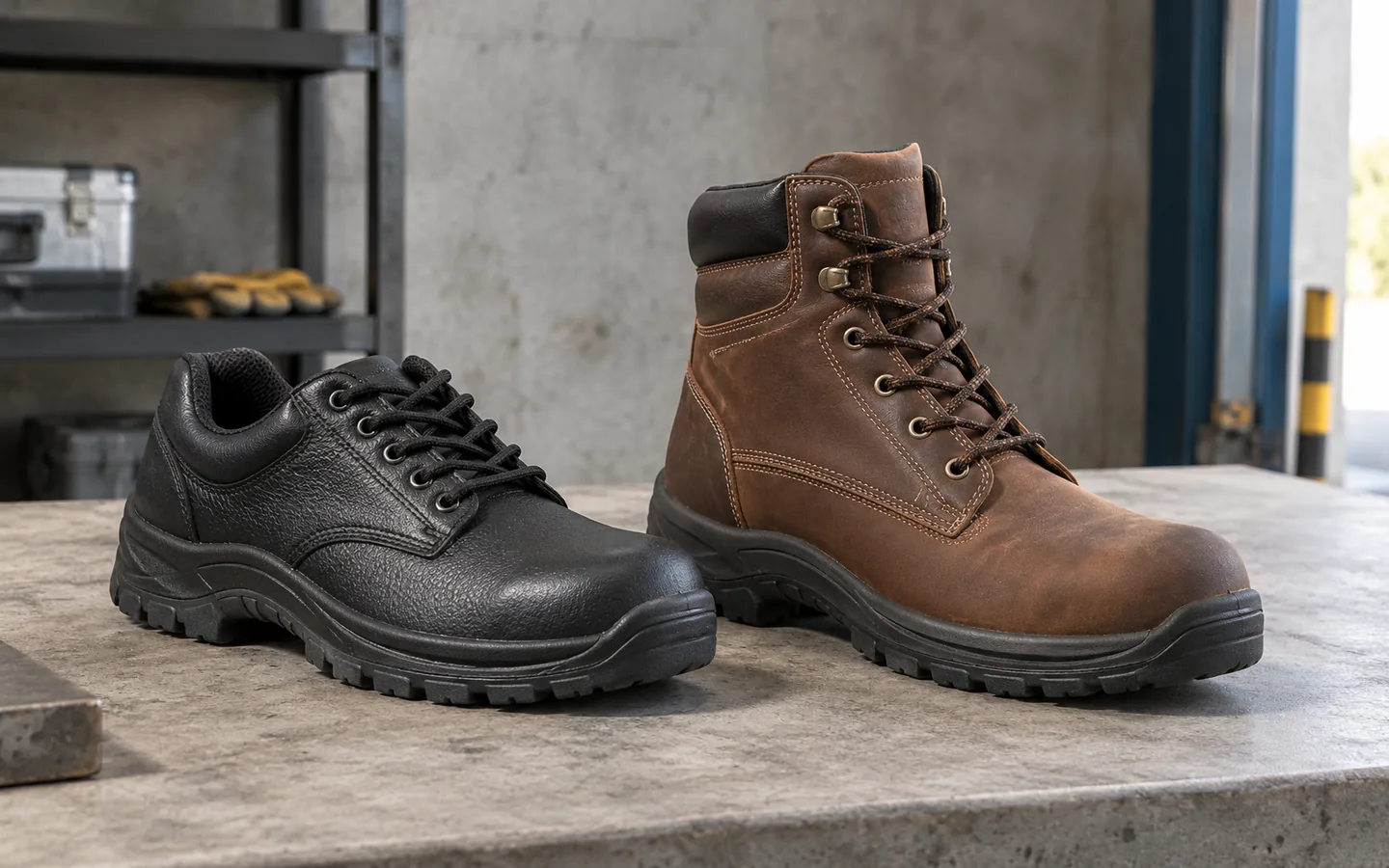
Safety shoes and safety boots can both form part of an industrial footwear program, but the correct format depends on the work rather than a universal preference. A low-cut shoe may suit a role that requires frequent movement in a controlled area, while a boot may be considered where the environment, job task or required coverage supports that format. Height alone does not establish the protective performance of the finished product.
This guide is written for PPE distributors, procurement teams, safety managers, importers and project buyers comparing footwear for a workforce or sourcing program. It provides a decision framework for defining the requirement, reviewing candidate models and approving samples without treating every shoe or every boot as technically equivalent.
1. Safety Shoes vs Safety Boots: The Main Difference
The most visible distinction is format. Safety shoes normally have a lower cut around the ankle, while safety boots extend higher. That difference can affect how a buyer evaluates coverage, entry and removal, movement, upper construction and use in a particular work area. It does not prove that one option has better toe, penetration, slip or other protection.
Protection comes from the complete model and its verified construction. Two products with different heights may carry similar protective components, while two products with the same general shape may have different markings, materials or documentation. Buyers should therefore compare format and protection as separate parts of the specification.
The commercial safety-shoe range is the appropriate place to compare available low-cut models. This article remains focused on the decision between formats rather than replacing that category.
2. When Safety Shoes May Be Appropriate
A safety shoe may be considered for indoor production, warehouse, inspection or other roles where regular walking, repeated changes of direction and a lower footwear profile are relevant to the job. The buyer still needs to establish the workplace hazards and verify that the selected model includes the required protective components and documentation.
Floor condition, shift pattern, climate, uniform requirements and the way workers enter or leave the work area can all affect the decision. A lower cut should not be described as automatically lighter, cooler or more comfortable. Those characteristics depend on the actual upper, lining, outsole, protective components, last, size and finished construction.
For a multi-role workforce, safety shoes may be one part of a controlled product matrix rather than the default choice for every employee. Record which roles share the same conditions and which require a separate assessment.
3. When Safety Boots May Be Appropriate
Safety boots may be evaluated for construction, mining, outdoor maintenance, material handling or other work where the buyer has identified a reason to consider a higher format. Relevant questions include exposure to uneven or dirty ground, movement between indoor and outdoor areas, the need for additional upper coverage, and the way the boot will be worn with work clothing.
A higher upper does not by itself establish ankle protection, waterproof performance, insulation, chemical resistance or suitability for rough terrain. Any such requirement must be defined separately and checked against the selected model's construction and supporting information.
The safety-boots category contains models with different uppers, outsoles and protective configurations. Use it to compare available products after the workplace and format requirements have been documented.
4. Compare Workplace Conditions Before Choosing A Format
Start with the areas where the footwear will actually be used. Indoor production may involve smooth floors, fixed workstations and repeated walking. Warehouse and logistics roles can combine picking aisles, loading areas, vehicle movement and long travel distances. Construction and mining can introduce unfinished surfaces, loose material, debris, changing weather and transitions between work zones.
Outdoor work, wet or dirty environments and uneven terrain do not automatically require the same boot. They require the buyer to document the exposure and ask how each proposed model addresses the specification. Likewise, a clean indoor area does not remove the need to assess falling-object, penetration or other hazards.
Where one project includes several environments, divide the workforce into practical role groups. A smaller number of justified specifications is usually more useful than either one universal model or an unnecessary model for every individual task.
- Work area: indoor, outdoor or mixed
- Surface: smooth, uneven, loose, wet, dirty or contaminated
- Movement: standing, walking, climbing, driving or repeated direction changes
- Exposure: falling objects, sharp debris, weather or other documented hazards
- Operational needs: cleaning, entry controls, uniform and shift pattern
5. Movement And Job Role Matter
Footwear selection should reflect what each role does during a normal shift. A production operator at a fixed station, a warehouse picker, a forklift operator, a construction installer and an outdoor maintenance worker may have different movement patterns even when they work for the same organization.
Buyers should document walking distance, standing time, use of steps or ladders, vehicle operation and movement between surfaces. These observations help define the preferred format and the questions to test during a wearer trial. They should not be converted into unsupported claims that one format prevents fatigue or provides a medical benefit.
Finished-shoe weight, flexibility and fit may differ between models. Do not assume that every shoe is lighter than every boot, or that lighter footwear is automatically safer or more acceptable. Compare the actual sample in the selected construction and sizes.
6. Protection Requirements Come Before Footwear Height
The workplace risk assessment and purchasing specification should identify the protection required before the buyer chooses a final model. Review the listed toe and midsole components, outsole construction, upper and any other required feature on the exact product record. Do not infer a component from the words safety shoe or safety boot.
Where an applicable standard such as EN ISO 20345 is required, buyers should verify the applicable marking, documentation and requirements for the selected model and destination market. A standard or protection class shown for one model must not be carried across to another model or to the complete category.
For an OEM or private-label project, changes to the upper, outsole, toe cap, midsole or other construction details may affect the product reference and documentation review. Confirm the final specification rather than relying on an earlier sample or a visually similar product.
- Selected model and final construction
- Required protective components
- Applicable marking or classification
- Model-specific supporting documents
- Destination-market and workplace requirements
- Any OEM changes made after the first sample
7. Fit, Sizing And Wearer Acceptance
A technically appropriate format can still create procurement problems if the approved size range and fit process do not match the workforce. Buyers should confirm the size system, expected size breakdown, available range and the exact model that will be supplied. A nominal size does not guarantee identical fit across different constructions.
Use representative samples to review toe room, heel hold, entry, closure, movement and compatibility with the intended work clothing. Gather structured wearer feedback from relevant roles, record exceptions and distinguish preference comments from failures to meet the written specification.
For bulk orders, retain the approved model, sample comments, size record and any agreed change. The dedicated bulk-order sizing guide explains this process in greater detail without changing the shoe-versus-boot decision covered here.
8. Safety Shoes vs Safety Boots Comparison Table
The table is a procurement prompt, not a performance ranking. Each point must be checked against the workplace and the finished model.
| Decision area | Safety shoes | Safety boots | Buyer verification |
|---|---|---|---|
| Footwear format | Lower-cut format | Higher-cut format | Confirm that the format suits the role, clothing and work area. |
| Movement | May be considered where frequent movement and a lower profile are relevant | May be considered where the role and environment support a higher format | Test the actual sample; do not infer weight, flexibility or comfort from format alone. |
| Coverage | Less upper coverage by format | More upper coverage by format | Do not convert height into an unsupported protection claim. |
| Environment | Often evaluated for controlled indoor or mixed roles | Often evaluated for outdoor, dirty, uneven or demanding areas | Document actual surfaces, exposure and transitions; exceptions are common. |
| Protection | Depends on the selected model | Depends on the selected model | Verify components, marking, documentation and workplace requirements. |
| Fit and sizing | Review low-cut fit, closure and heel hold | Review entry, closure, upper fit and interaction with work clothing | Approve representative sizes and record wearer feedback. |
| Procurement record | Model, construction, size mix and approved sample | Model, construction, size mix and approved sample | Keep final specification and documents aligned with the supplied product. |
9. Procurement Checklist Before Selecting Shoes Or Boots
A concise record helps procurement, safety and supplier teams compare proposals on the same basis. Complete the checklist before requesting a final quotation or approving a bulk-production reference.
- List the job roles and work areas included in the program.
- Record the relevant hazards, floors, terrain, climate and movement patterns.
- State why a lower or higher format is being evaluated.
- Define required protective components and applicable specifications.
- Request model-specific markings and supporting documents.
- Confirm upper, lining, outsole, closure and other construction details.
- Review the available size range and prepare a provisional size breakdown.
- Evaluate representative samples with structured wearer feedback.
- Document branding, packaging and any OEM construction changes.
- Approve the final model, sample, size record and required documents together.
10. Which Should An Industrial Buyer Choose?
Choose the format that best matches the documented role, environment and procurement specification, then verify the protection and fit of the exact model. Some programs may use safety shoes for controlled, movement-intensive roles and safety boots for outdoor or higher-coverage requirements. Other workplaces may reach a different conclusion after assessing their hazards and operating conditions.
There is no universal winner between safety shoes and safety boots. A defensible decision connects the workplace assessment to the selected construction, model-specific evidence, size plan and approved sample. If several roles cannot be served by one justified specification, define a small, controlled range rather than forcing one format across the entire workforce.