
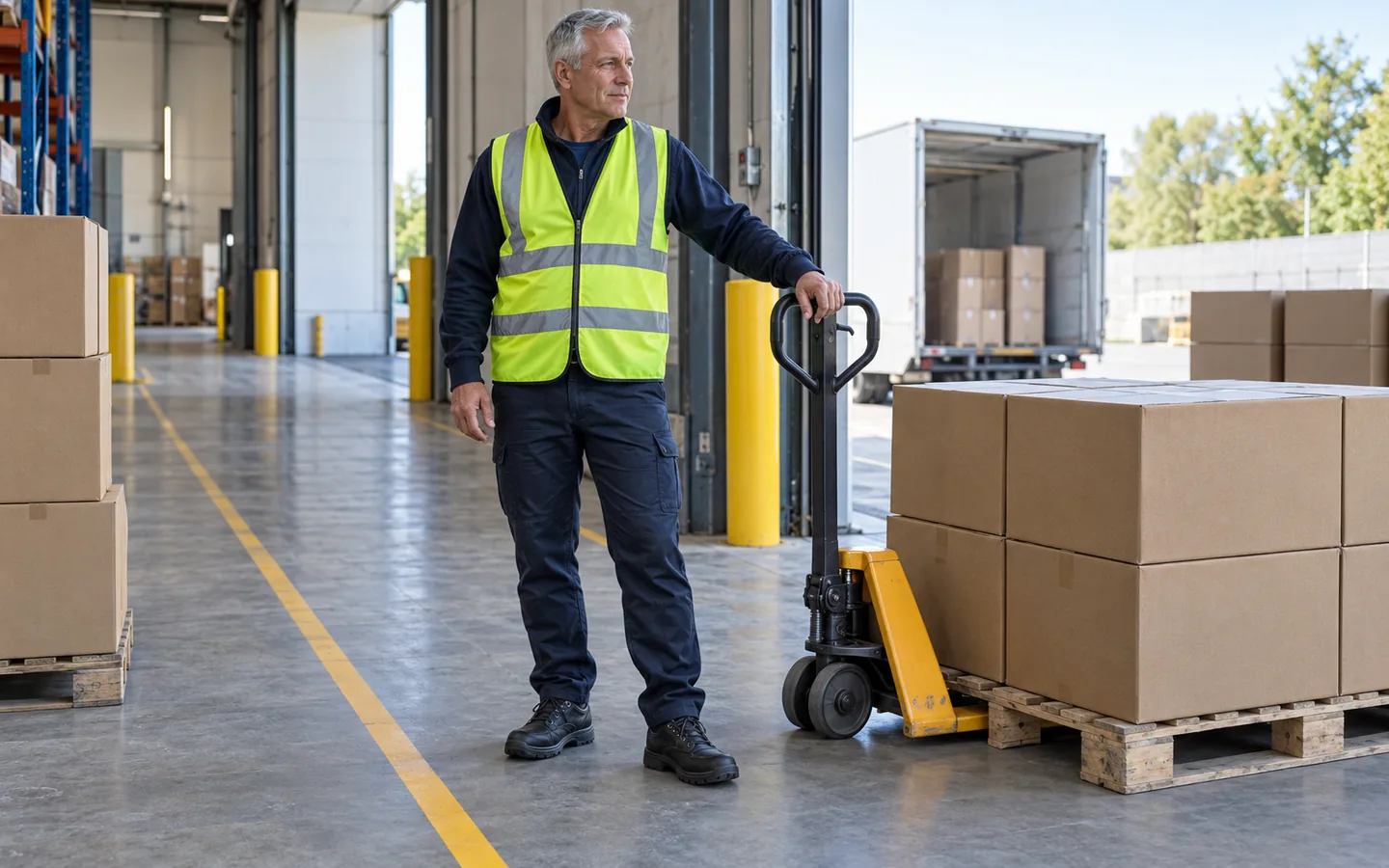
Warehouse safety shoes should be selected from the work being done, the floor underfoot and the protection required for each role. A picking team, a forklift operator and a loading crew can share a facility without facing identical risks, so one product name is not a complete specification.
For PPE distributors, importers and procurement teams, the practical question is not which shoe is universally best. It is which finished configuration can be supported by the workplace risk assessment, destination-market requirements, model documentation and an approved sample.
1. Start With Warehouse And Logistics Risks
Warehouse and logistics operations can involve falling packages, pallet handling, forklift operating areas, ramps, uneven loading surfaces and repeated walking. Floors may be affected by dust, water, oil, liquid spills or packaging debris. Long periods of standing, picking, packing, loading and unloading also change what wearers need from fit and flexibility.
Map these conditions by job role rather than treating the whole site as one environment. This makes it easier to decide whether workers need toe protection, penetration protection, additional ankle coverage or a particular outsole construction.
2. Compare Steel Toe And Composite Toe Options
Steel toe caps and composite toe caps can both be considered where protective toe footwear is required. Buyers should compare the required protection, the complete shoe construction, internal fit and finished-shoe weight instead of selecting only by toe-cap material.
Composite options may be relevant when a project has a metal-detection or metal-free requirement, but a composite toe does not automatically make the entire shoe metal-free. Eyelets, fasteners, midsoles and other components also need to be checked. The appropriate choice depends on the working environment and the customer specification.
3. Make Slip Resistance A Procurement Priority
Slip resistance deserves focused review in warehouse safety footwear because the surface can change during a shift. Dust, water, oil and packaging debris can affect traction, while ramps and transitions between indoor and loading areas can introduce different footing conditions.
Review the finished outsole, tread design and outsole material against the actual floor and contaminants. A material label or tread appearance alone does not prove performance for every surface. Ask for the applicable model marking and supporting information, then compare it with the site requirements and an appropriate sample evaluation.
4. Balance Protection With Lightweight, Flexible Design
Warehouse workers may walk long distances, stand for extended periods, turn frequently and repeat picking or packing movements. Weight, flexibility and the way the complete shoe moves with the wearer can therefore matter alongside protection.
Do not use a generic lightweight claim as a substitute for product review. Toe cap, midsole, upper, outsole, size and shoe height all affect finished weight. Compare samples in the intended size and configuration so buyers can assess fit and movement in context.
5. Select The Outsole For The Real Working Conditions
PU outsoles are often considered for many indoor applications where a balance of light weight and flexibility is useful. Dual-density PU constructions can combine layers with different roles, but the final properties depend on the specific construction and outsole geometry.
Rubber outsoles are often evaluated for demanding industrial environments and may offer heat-resistant options depending on the construction and model evidence. Neither PU nor rubber is automatically the right choice. Match the outsole to the floor, contamination, temperature, walking pattern and required protection, then confirm the exact model specification.
6. Review Comfort For Long Working Hours
Comfort review should be part of a buyer specification, not an afterthought. Check fit, toe-room profile, flexibility, finished weight, cushioning approach and breathability where applicable. For roles that work outdoors, on ramps or in wet conditions, ankle coverage and upper construction may also need review.
These factors support practical wearability, but they do not replace a workplace risk assessment or create a medical claim. A wearer trial with representative users can provide useful feedback on fit and movement before a larger order is approved.
7. Choose Between Safety Shoes, Work Shoes And Safety Boots
Safety shoes can suit roles that need foot protection while retaining a lower, flexible profile for regular movement. Work shoes may be considered for lower-risk tasks or positions that do not require a specific protective toe configuration, subject to the employer's risk assessment and customer requirements.
Safety boots can be relevant for wet environments, outdoor logistics, more demanding industrial areas or work that benefits from additional ankle coverage. The choice should follow the job and the required protection, not a general assumption that one product type is safer for every worker.
8. Confirm The Required Standard And Model Evidence
Before ordering, confirm the destination market, applicable safety standard and the exact protection requirements. Do not turn a general website statement or a similar sample into a claim for a different model or customized construction.
Ask for the technical specification, product marking and relevant supporting documents for the exact finished product. If toe cap, midsole, outsole, upper, logo or other construction details change during an OEM project, confirm whether the change affects the required testing or documentation.
9. Use A Practical Buyer Checklist
A complete sourcing brief helps a supplier evaluate a suitable warehouse or logistics safety-footwear configuration and reduces late changes during sampling.
- Application, worker role and work environment
- Required safety standard and destination market
- Toe-cap type and midsole protection
- Outsole material, tread and slip-resistance requirement
- Waterproof or heat-resistance requirement where applicable
- Upper material, fit expectations and size range
- Logo, packaging and order quantity
- Required documents, sample approval and delivery destination
10. Move From Risk Assessment To Supplier Confirmation
A defensible sourcing process follows a clear sequence: risk assessment, protection requirements, product configuration, applicable safety standard and supplier confirmation. This sequence keeps buyer decisions connected to the actual work rather than to broad product labels.
Future Tech can support safety-footwear sourcing and OEM/ODM requirements based on the application and market needs. Share the working conditions, target market, required protection, sizes, quantity and customization requirements so the relevant model or configuration can be reviewed.