
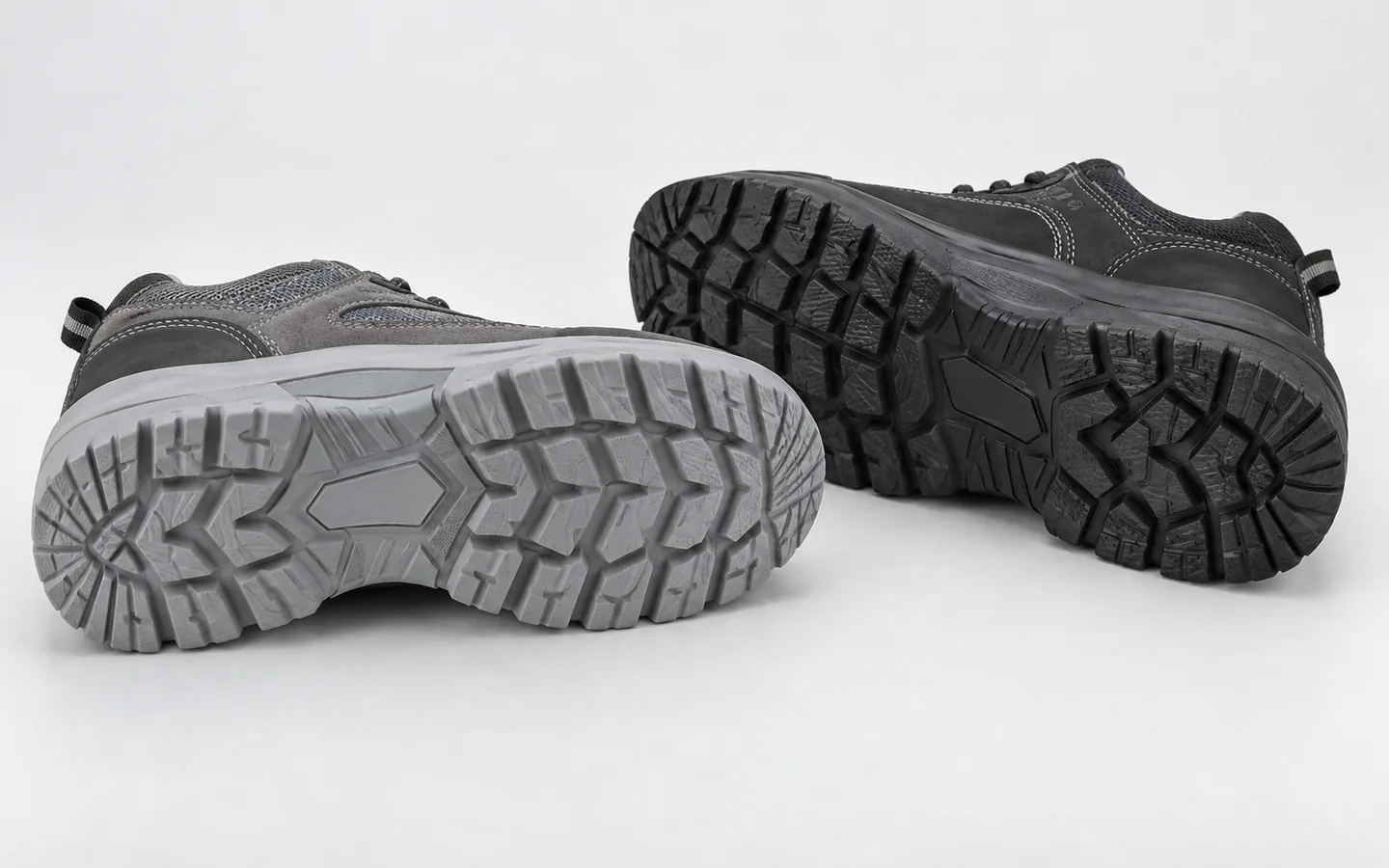
PU and rubber are common outsole materials in safety footwear, but neither is automatically better for every workplace. The right choice depends on floor conditions, heat exposure, flexibility, weight targets, abrasion, chemicals, climate and the construction of the complete shoe.
PU constructions are commonly evaluated for a balance of weight, cushioning and flexibility, while rubber constructions are often evaluated for demanding surfaces, abrasion and heat-related applications; final suitability still depends on the finished model and supporting evidence.
Buyers should compare model-specific evidence instead of selecting from a material label alone. PU, dual-density PU, rubber and PU/rubber combinations can be engineered differently, so the finished footwear specification matters more than a generic material claim.
1. Start With The Workplace
Define where the footwear will be used and what the outsole must do. A clean indoor warehouse, a wet construction site, a manufacturing workshop and a mining road place different demands on tread, stability and durability.
Record the floor material, contamination, ramps, outdoor exposure, temperatures, walking distance and any customer-specific test or marking requirement.
2. How PU Outsoles Are Commonly Used
Polyurethane outsole constructions are often considered where buyers value a balance of weight, cushioning and flexibility. Single- and dual-density PU constructions can be designed for different use cases, and the formulation and sole geometry affect the final result.
Do not assume that every PU sole has the same slip, abrasion, chemical or thermal performance. Confirm the exact model specification and supporting test information.
3. How Rubber Outsoles Are Commonly Used
Rubber outsoles are frequently evaluated for demanding surfaces, abrasion and heat-related applications. Formulation, hardness, tread and bonding construction still vary substantially between products.
A rubber outsole is not proof of HRO, universal chemical resistance or superior slip performance. Each of those claims requires the relevant model marking or evidence.
4. Understanding PU/Rubber Combinations
A PU/rubber construction can combine a PU midsole with a rubber contact layer. Buyers may consider this approach when they want the design advantages of both materials, but the actual balance of weight, flexibility, heat performance and durability depends on the finished sole.
Check bonding, outsole thickness, tread depth and sample performance rather than treating the material combination as a guaranteed upgrade.
| Evaluation area | PU | Rubber | Required verification |
|---|---|---|---|
| Common buyer consideration | Balance of weight, cushioning and flexibility | Demanding surfaces, abrasion and heat-related applications | Finished model specification |
| Slip performance | Not determined by material alone | Not determined by material alone | Tread, test conditions and applicable evidence |
| Heat / chemical requirements | Cannot be assumed from PU alone | Rubber does not automatically establish HRO or chemical resistance | Model marking and supporting documentation |
| Procurement decision | Compare formulation, geometry and complete shoe | Compare formulation, hardness, tread and bonding | Approved sample and workplace requirements |
5. Compare Weight And Flexibility
Finished-shoe weight and flex behaviour depend on far more than the outsole. Toe caps, penetration-resistant inserts, upper materials, boot height and sole dimensions also contribute.
Compare complete samples in the required size. A material-level statement should not be used as a substitute for weighing or flexing the actual model.
6. Compare Slip Performance Carefully
Slip resistance depends on the finished outsole, tread, test condition and surface. Neither PU nor rubber should be described as slip resistant in every environment based only on the material name.
Request the applicable marking and supporting evidence, then compare it with the site's real floors and contaminants. Where practical, include a wearer trial on representative surfaces.
7. Review Heat, Oil And Chemical Conditions
If workers face hot surfaces, oils or chemicals, document the substance, concentration, contact pattern and temperature. General phrases such as oil resistant or chemical resistant are too broad for a procurement specification.
Use model-specific documentation and applicable markings. For specialized chemical or electrical hazards, complementary standards may be needed beyond general safety-footwear certification.
8. Check Durability And Bonding
Outsole life is affected by formulation, abrasion, tread geometry, bonding, storage and actual use. Buyers should inspect an approved sample and agree on construction controls rather than relying on a universal service-life claim.
For OEM projects, changing outsole material or pattern can affect testing, mould requirements, sampling and lead time. Confirm these implications before final design approval.
9. Use A Practical Comparison Checklist
Ask suppliers to state the complete construction and the evidence for the required application.
- Workplace floors, contamination and outdoor exposure
- Required standard and slip or heat markings
- Outsole and midsole material construction
- Tread pattern, thickness and bonding method
- Finished-shoe weight and flexibility
- Toe cap and puncture-resistant insert
- Size range, sample needs and wearer trial
- Customization, testing and document scope
10. Review Climate, Storage And Ageing
Storage temperature, humidity, direct sunlight and the time between production and use can affect footwear materials. Buyers should request storage guidance for the exact construction and make sure warehouse practices support it. Avoid assuming that one generic shelf-life statement applies to every PU or rubber formulation.
For projects with seasonal demand or long transport routes, include packaging, storage and stock-rotation expectations in the sourcing discussion. This is particularly important when footwear may remain in a distributor warehouse before it reaches the wearer.
11. Compare Samples Under The Same Criteria
When comparing PU and rubber options, use the same size and a documented checklist. Record finished-shoe weight, fit, flexibility, tread, outsole hardness information when available, required markings and the documents supplied with each model. A visual comparison alone cannot establish slip, heat or chemical performance.
If a wearer trial is appropriate, select representative users and surfaces. The trial can reveal fit and movement concerns, but it should not be presented as a substitute for laboratory testing or the buyer's workplace risk assessment.
12. Account For OEM Changes
Changing an outsole is not always a simple material substitution. A new tread, colour, compound or bonding construction may require a different mould, sample, test plan or production setup. Buyers should identify which changes are essential and approve the revised construction before bulk production.
Future Tech Ltd. can customize sole material and outsole pattern, subject to the selected model, order quantity and required safety standard. Certification requirements, cost and timing for a customized product are confirmed for the specific project and should not be inferred from an existing model.
13. Choose The Finished Product, Not Just The Material
PU may suit one purchasing program while rubber or PU/rubber is more appropriate for another. The defensible decision is the one that matches hazards, required markings, model documents and an approved sample.
Future Tech Ltd. offers safety shoes, safety boots and work shoes with different outsole constructions. The team can review an existing model or an OEM brief after the workplace, standard and performance requirements are defined.