
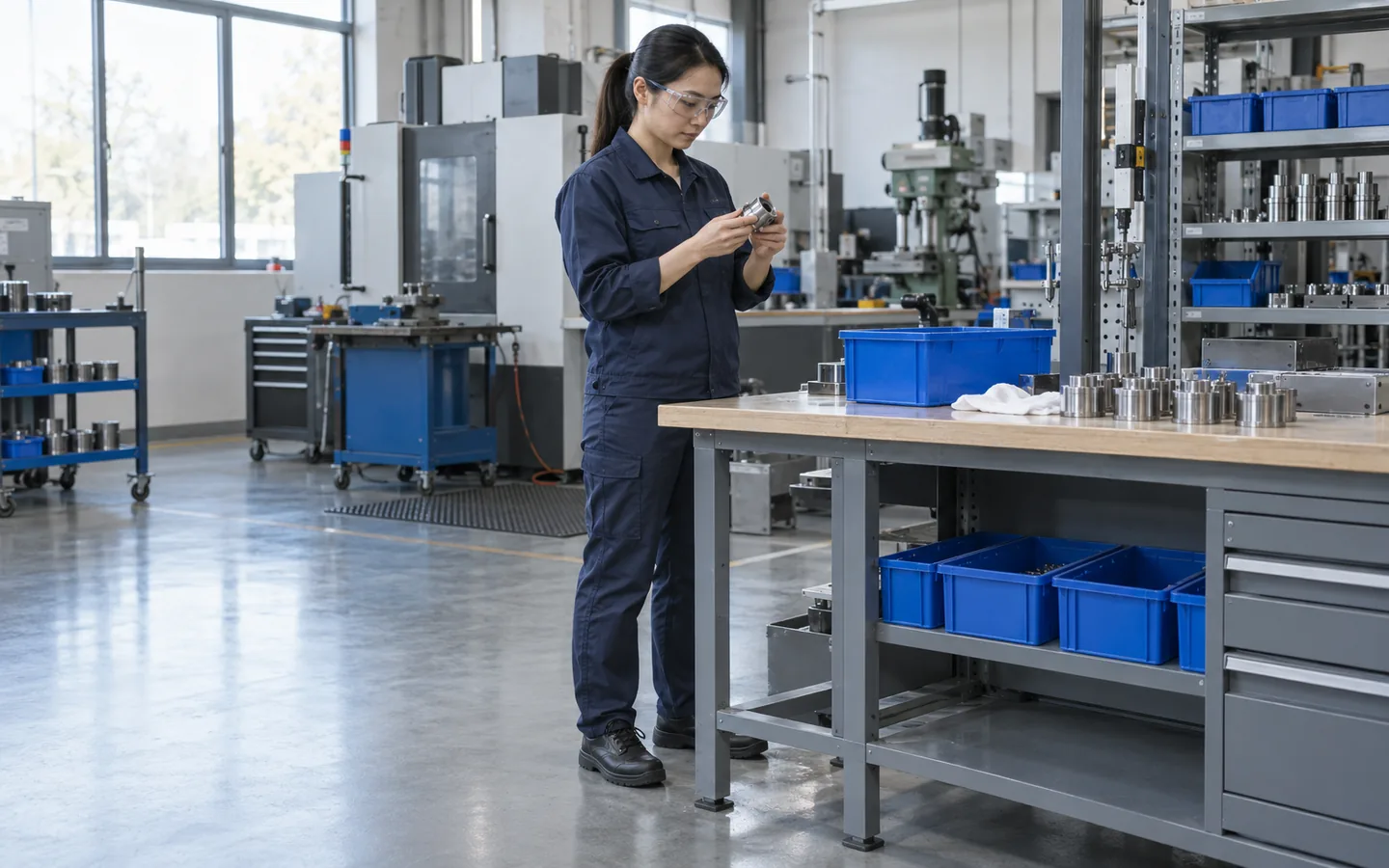
Should every worker in a manufacturing facility wear exactly the same safety footwear specification? Often the answer depends on the production role, floor, movement pattern and component exposure. An assembly operator, maintenance technician and material-handling worker can share a building without sharing the same footwear requirement.
This guide helps B2B buyers turn factory observations into a manageable, role-based sourcing program. It is not a generic guide to selecting safety shoes. The purpose is to define the information a supplier needs before a model, sample and bulk order can be reviewed.
1. Why Manufacturing Footwear Specifications Should Be Role-Based
Manufacturing facilities combine production lines, assembly areas, maintenance spaces, material routes and inspection areas. Each has a different mix of movement, floor condition, equipment and object-handling exposure. One universal specification may be suitable for some roles, but it should be justified by a documented comparison rather than assumed for the entire workforce.
Start by grouping jobs with genuinely similar conditions. This makes the program easier to manage while preserving a clear reason for each footwear configuration.
2. Map Footwear Requirements By Production Area
Production-line roles may involve fixed positions and repeated movement; assembly areas may combine smooth floors with parts handling; maintenance teams may encounter changing surfaces and debris; material-handling teams may move between storage and production; inspection areas may require a different balance of protection and mobility. Record the actual task before choosing a category.
The resulting map should state the role, primary hazard, floor, movement, required components and preferred footwear format. It is a procurement tool, not a substitute for the employer's risk assessment.
3. Understand The Factory Floor
Smooth industrial floors, walking distance, standing time, transitions between areas and surface contamination all affect the sourcing conversation. Buyers should describe the floor as it is used, including ramps, wet-cleaning exposure or areas where residues may be present. A general slip claim should not be inferred from a sole material or product image.
Ask for the listed outsole construction and relevant model information, then compare it with the actual workplace. A sample can help assess fit and movement, but it does not prove performance on every factory surface.
4. Toe Protection By Job Function
Steel and composite toe options should be assessed against the role-specific protection requirement and the selected model documentation. The choice should not be based solely on a general preference for one material. Internal fit, finished construction and any metal-free requirement should be recorded in the buyer brief.
For a multi-role program, note which jobs require protective toe footwear and which specific component is requested. Do not extend a model's protection class or certificate to another model with a similar appearance.
5. When Should Buyers Consider Midsole Protection?
Midsole selection should follow the documented penetration risk for each production area. Maintenance, repair and material routes may not have the same sharp-object exposure as a controlled assembly area. Buyers should request the exact listed midsole construction for the proposed model and confirm it for the final order.
Avoid treating a product category as proof that every model contains the same protective insert. The approved specification should identify the selected product, component and documentation needed for that role.
6. Outsole Selection For Manufacturing Floors
Outsole selection is a factory-floor decision: consider the surface, contamination, walking pattern and shift demands together. PU, rubber and combined constructions may be available in the catalog, but their suitability remains model- and application-specific. The detailed outsole article can support material research without replacing a factory-specific brief.
For procurement, record the requested construction and the conditions it is intended to address. Confirm the actual model rather than carrying a generic outsole claim across a wider program.
7. Weight And Long-Shift Comfort
Long standing and repeated walking make fit, lining, insole, flexibility and finished-shoe weight relevant buying considerations. These factors should be reviewed alongside protection, not as unsupported health or fatigue claims. Sample feedback from representative users can reveal issues with toe room, heel hold or movement before bulk ordering.
Compare samples in the intended size and configuration. Different toe caps, midsoles, uppers and outsoles can affect how a finished product feels, so a similar-looking model is not a reliable substitute.
8. Safety Shoes, Work Shoes Or Safety Boots?
A manufacturing program may include safety shoes, work shoes and safety boots where the job requirements differ. Safety footwear should be selected where the role requires the listed protective components; work shoes should not be presented as a substitute where protection is required. Boots may be evaluated where the work environment and configuration support that format.
The aim is a sensible product mix, not a broad claim that one format suits every department. Link each format to the documented role and selected model.
9. One Specification Or Multiple Specifications?
A single specification can simplify purchasing when roles, floors and hazards are closely aligned. Multiple specifications can be more defensible when production, maintenance and material handling have materially different conditions. Buyers should compare the operational benefit of standardization with the risk of over- or under-specifying footwear.
Use a small number of role groups and document why each group can share a configuration. This is the key distinction between a manufacturing footwear program and a generic product selection exercise.
10. Sample Evaluation Before Bulk Ordering
Review size, fit, materials, construction, outsole, required toe or midsole components and product identification against the written role specification. Check that the required documents relate to the selected model and final configuration. A wearer trial can be useful where movement and fit are important.
Record changes before production. If a project changes the upper, outsole, protective component or other construction detail, confirm whether documentation and sample approval need to be revisited.
11. Manufacturing Safety Footwear Buyer Checklist
A completed checklist should make the final order traceable from factory role to approved model. It gives purchasing, safety and supplier teams one reference for comparing samples and production.
- Production area and job role
- Floor and movement conditions
- Primary toe or midsole requirement
- Requested outsole and upper construction
- Safety shoe, work shoe or boot format
- Size breakdown, quantity and packaging
- Model-specific documentation and sample approval
12. Sourcing Manufacturing Safety Footwear
Future Tech offers safety shoes, safety boots and work shoes with different catalog-listed constructions. Buyers can begin with the manufacturing industry page, then review safety shoes, work shoes and S1P safety shoes against the confirmed role brief. Final model suitability and any customized configuration require project-level confirmation.
Provide the production roles, floor conditions, target market, required components, sizes and quantity. This creates a practical basis for a model review or an OEM discussion.