
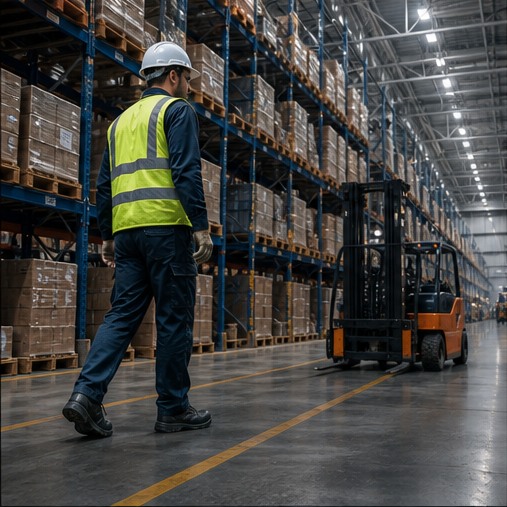
Warehouse workers do not all move through the same conditions. Order pickers may walk and turn repeatedly, forklift operators move between driving and material-handling tasks, loading teams work across ramps and changing surfaces, and packing teams may spend longer periods standing in one area.
For safety managers, warehouse operators, PPE distributors and procurement teams, the practical task is to define footwear requirements by job role. Floor conditions, movement patterns, identified hazards, fit observations and representative wearer feedback should be recorded before a model or configuration is approved.
1. Why Warehouse Job Roles Need Different Footwear Requirements
A warehouse label does not describe how every employee works. Role groups can differ in walking distance, turning frequency, vehicle use, time spent standing, cargo exposure and the surfaces crossed during a shift. Those differences should be documented before footwear requirements are compared.
One specification may still serve several roles when their hazards and working conditions are genuinely aligned. The decision should be supported by the role assessment, selected model information and sample feedback rather than assumed for the whole facility.
2. Order Pickers And Walking-Intensive Roles
Order pickers may cover repeated routes, change direction frequently and move between shelving, packing points and replenishment areas. Buyers should record walking distance, turning, bending, use of steps or platforms and any transitions between floor zones.
Fit, flexibility, lining, insole and finished-footwear weight can be reviewed together with the required protection. Buyers may evaluate lightweight work shoes where the role assessment supports that category, but lightweight construction alone does not establish that a model is suitable for every picker or warehouse environment.
3. Forklift Operators And Material-Handling Roles
Forklift operators may alternate between seated driving, repeated vehicle entry and exit, short walking tasks and work around pallets or moving equipment. The assessment should reflect the full role rather than only the time spent inside the vehicle.
Record pedal use, access steps, surrounding traffic, cargo-handling exposure and the floors encountered away from the vehicle. Toe or penetration protection should be specified only when the identified hazards and applicable requirements call for it, then verified for the selected model.
4. Loading And Unloading Teams
Loading and unloading teams can move between warehouse floors, loading bays, dock plates, ramps and vehicle interiors. Surfaces may change during the task and may be affected by water, dust, packaging debris or other site-specific contamination.
Cargo handling, moving equipment and sharp debris should be assessed for the actual loading role. The resulting footwear requirement should connect each identified hazard to a feature that the buyer will confirm through the exact model and its supporting documentation.
5. Packing And Standing-Intensive Roles
Packing, inspection or dispatch roles may involve prolonged standing, shorter walking routes and repeated turning within a defined station. Their movement pattern differs from a picker who travels continuously through the facility, even when both roles work on the same floor.
Sample review should consider size, toe room, heel hold, flexibility and underfoot feel for the intended task. These observations help compare models, but they should not be turned into medical claims or promises that footwear will prevent fatigue.
6. Compare Floor And Movement Conditions By Role
Record the surfaces each role actually crosses: dry or wet areas, smooth floors, ramps, dock zones, outdoor transitions and locations exposed to oils or other contaminants. A role that stays in one controlled zone may require a different review from a team moving repeatedly between indoor and loading areas.
Outsole material and tread appearance alone do not prove performance on a particular floor. Buyers should compare the finished model, applicable marking and supporting information with the documented conditions, while treating practical wearer observations as operational feedback rather than test evidence.
7. Match Protection To The Actual Role Hazard
Toe and puncture-protection requirements should follow the workplace risk assessment for each role. A picker, forklift operator, packing worker and loading team may not face identical impact or sharp-object hazards, so protective components should not be added or removed solely because the roles share a building.
If ESD or antistatic performance is required by a particular work zone, buyers should define the exact site requirement and verify the selected model documentation. The warehouse application itself does not demonstrate that every model provides those properties.
8. Evaluate Fit And Comfort Across Long Shifts
Walking, standing, turning and vehicle access place different demands on the wearer. Review the intended size range, internal fit, toe room, heel hold, lining, insole, flexibility and finished-footwear weight with the required protection configuration in place.
Avoid unsupported descriptions such as fatigue free or suitable for every long shift. Fit and comfort are influenced by the wearer, size and complete construction, which is why representative samples are more useful than assumptions based on a product photograph or one material name.
9. Run A Role-Based Sample And Wearer Trial
Choose representative workers from the role groups the footwear is intended to serve. Use consistent evaluation criteria for walking, standing, turning, vehicle entry or exit and normal task movement, and record observations about fit, heel hold, toe room, flexibility and practical use.
A wearer trial can reveal fit or movement concerns before a wider order is approved. It does not replace laboratory testing, certification evidence or the employer's risk assessment. If the sample construction changes, confirm the revised product and supporting documents before relying on the earlier feedback.
10. Convert Job-Role Findings Into A Footwear Specification
Summarize each role group by its movement pattern, floor or work zone, identified hazards, required protection, fit considerations and sample feedback. This gives the supplier a controlled basis for reviewing a model without turning the article into a universal product recommendation.
- Worker role group and normal tasks
- Walking, standing, turning and vehicle-use pattern
- Floor conditions and work-zone transitions
- Hazards identified by the workplace assessment
- Protection features requiring model verification
- Fit observations and representative trial feedback
- Documents requiring supplier confirmation