
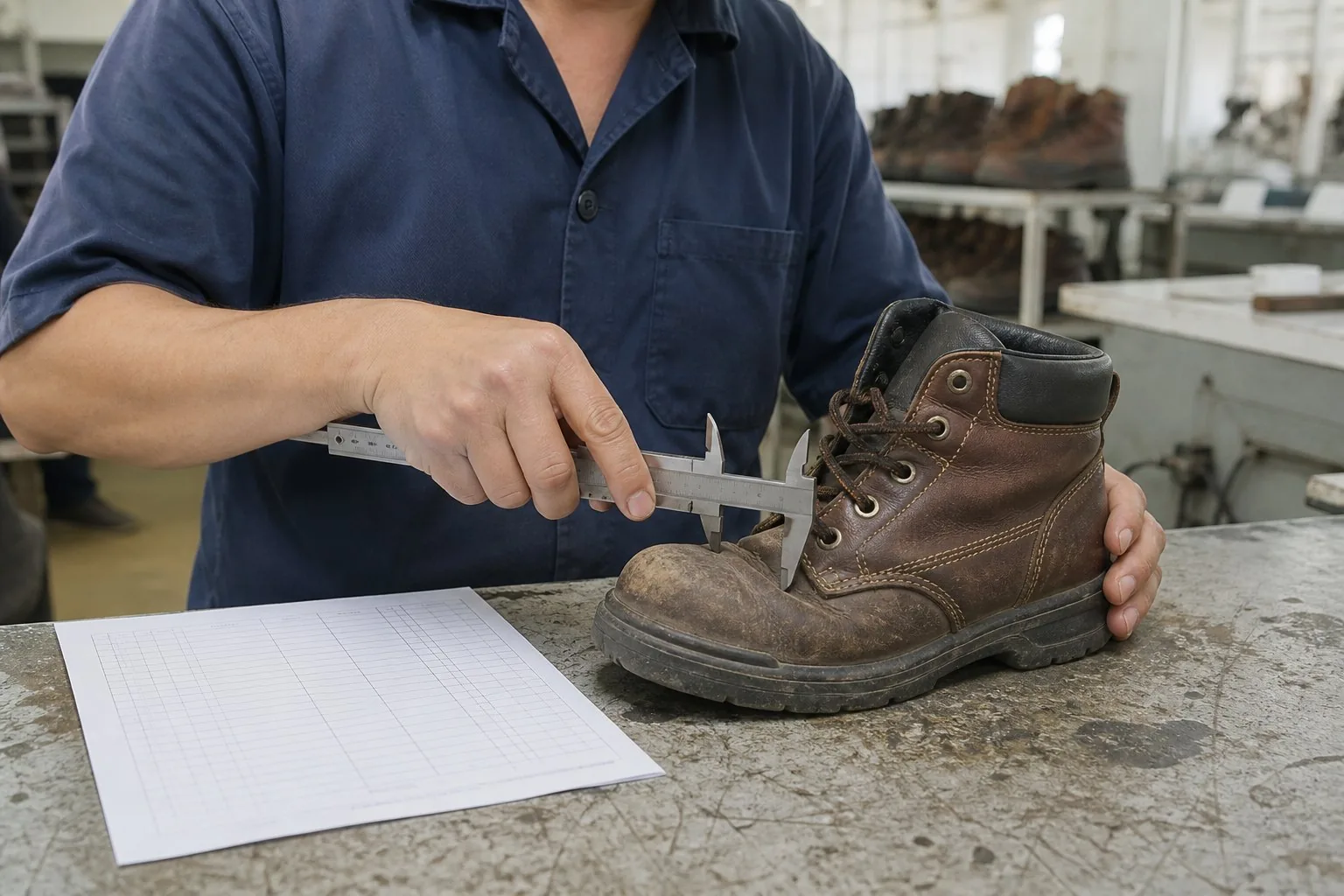
EN ISO 20345:2022 is the European adoption of the current ISO safety-footwear standard. It gives buyers a common framework for checking protective toe caps, classifications and additional performance markings, but it does not turn every certified shoe into the same product. Purchasing teams still need to match the exact model, marking and supporting documents to the intended workplace.
Every product currently displayed by Future Tech Ltd. is EN ISO 20345 and CE certified. Specific classifications and performance values vary by model, so S1PS, S3S, SR, PL, PS and other claims must be verified against the selected product rather than applied to the whole range.
1. What The Standard Covers
The standard specifies basic and additional requirements for general-purpose safety footwear. These include mechanical risks, slip resistance, thermal risks and ergonomic behaviour. Specialized risks such as electrical insulation, chainsaw protection, chemicals or molten-metal splash may require complementary standards, so an EN ISO 20345 certificate alone should not be treated as evidence for every hazard.
For procurement, the standard is a verification system. The product identification, complete marking, technical specification, test evidence and approved sample should describe the same construction.
2. Protective Toe Caps And The 200 J Requirement
Safety footwear under EN ISO 20345 includes a protective toe cap tested against the applicable impact and compression requirements. Buyers often refer to 200 J toe protection, but the material name alone does not prove compliance. Steel and non-metallic toe caps must be evaluated as part of the finished footwear.
Ask the supplier to identify the exact toe-cap construction and the model-level documents that support the marking. Fit, internal toe room and finished-shoe weight should also be checked during sample approval.
3. Understanding S1PS And S3S
Classifications group several requirements. Under the newer marking system, S1PS and S3S communicate combinations that include penetration resistance tested with a small nail, while S3S also addresses conditions associated with the S3 classification. The classification is useful for screening products, but buyers still need to review the complete marking and intended environment.
An indoor distribution center, a wet construction site and an open-pit mine do not have the same risk profile. Select the class after documenting water exposure, floor conditions, sharp-object hazards and customer requirements.
4. PL And PS Puncture-Resistance Markings
PL and PS relate to non-metallic penetration-resistant inserts tested under different nail conditions. They should not be used as generic synonyms for every textile or Kevlar midsole. A steel insert follows a different marking route.
When penetration protection is required, request the exact marking, insert material, test documentation and finished-shoe specification. Do not infer PL or PS from a product photograph or from the phrase anti-puncture alone.
5. What SR Means For Slip Resistance
SR is an additional slip-resistance marking under the newer standard. It does not mean a shoe will prevent every slip on every surface. Floor material, water, oil, cleaning chemicals, tread wear and worker movement all affect real use.
Buyers should compare the model marking with the actual site conditions and, where practical, evaluate samples on representative floors. Avoid mixing older SRC terminology with newer SR terminology without confirming the applicable standard edition.
6. Read The Full Marking, Not One Badge
A product may also carry markings related to water resistance, heat contact, energy absorption or other properties. Each marking has a defined scope. A catalogue statement should identify the exact model and should not combine unrelated claims unless the same product evidence supports them.
CE is not a protection class. It forms part of the European conformity framework, while the product classification and additional markings communicate tested footwear properties.
7. Documents Buyers Should Verify
Agree on the document package before approving the sample or placing a bulk order. The information should be current, legible and traceable to the selected model.
- Exact model name and product identification
- Applicable EN ISO 20345 edition
- Complete product marking and classification
- Technical specification and material construction
- Relevant certificate, test report or conformity documentation
- Name of the issuing or testing organization where applicable
- Confirmation that customization has not changed the tested construction
8. Customized Products Need A Separate Review
Changing an upper, toe cap, anti-puncture insert, outsole, construction method or other safety-related component can affect the evidence that applies to the product. The approved sample and documents should therefore match the final customized configuration.
Future Tech Ltd. accepts customized safety-footwear projects and can support certification. The applicable standard, test scope, process, timing, cost and outcome are confirmed for each project; certification should never be promised before those requirements are reviewed.
9. A Practical Buyer Approval Sequence
Start with the destination market and workplace risk assessment. Prepare a written specification, shortlist products with the required markings, review the model-level documents, approve a physical sample and then freeze the construction for production.
This sequence helps procurement teams compare like with like. It also prevents a certificate for one construction from being used as evidence for a different model or an unapproved customization.