
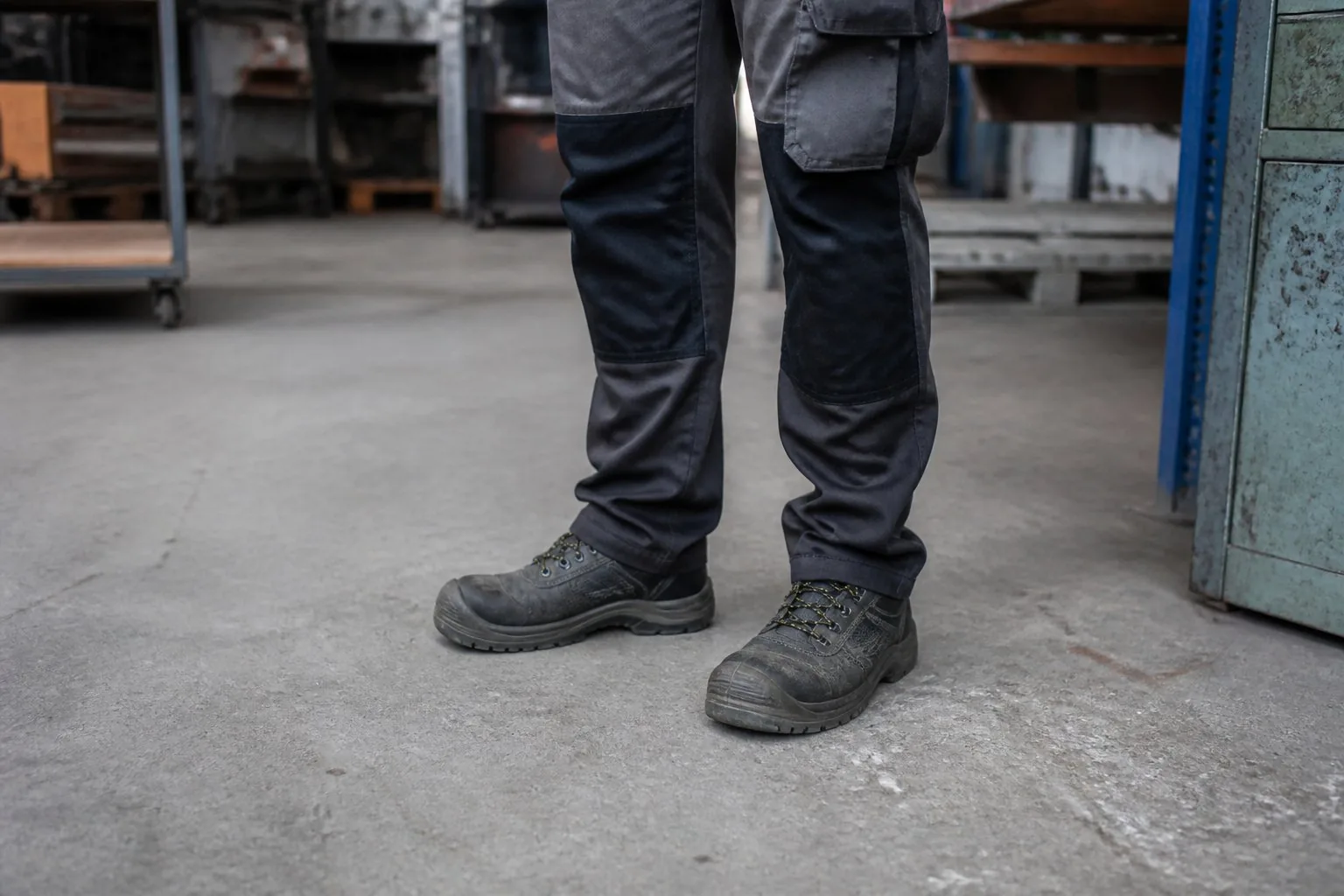
Choosing safety shoes for industrial work starts with the task, the workplace hazards and the requirements of the destination market. The product name alone is not enough: buyers should review the complete footwear construction, supporting documents and an approved sample before placing a bulk order.
A useful sourcing brief connects each workplace risk to a product requirement. This makes it easier to compare existing models, identify customization needs and avoid specifying protection that is unnecessary or unsupported.
1. Map The Workplace Hazards
Begin with a written risk profile for each job. Construction debris, moving loads, smooth warehouse floors, water exposure and hot surfaces create different footwear requirements.
- Falling or rolling objects
- Sharp debris and penetration hazards
- Wet, oily, smooth or uneven floors
- Water or heat exposure
- Walking distance, standing time and worker movement
2. Confirm The Required Standard
Confirm the destination market, the applicable standard edition and any customer-specific documentation before selecting a model. Every product currently displayed by Future Tech Ltd. is EN ISO 20345 and CE certified, while individual protection classes and performance markings vary by model.
Ask for the technical specification and supporting documents for the exact model. Do not apply an S1P, S3, slip-resistance, 200J or 1100N claim to a product unless that product's documentation supports it.
3. Select Toe And Penetration Protection
Steel and composite toe caps can both be evaluated against a required protection level. The decision should also consider finished-shoe fit, weight and whether the complete specification needs to be metal-free.
For penetration hazards, compare steel and textile or Kevlar midsole options as part of the complete shoe. Flexibility, construction and supporting test information matter more than the material name alone.
4. Evaluate The Outsole And Upper
Match the outsole to the real floor and contamination risk. Future Tech Ltd. products use different constructions, including PU, PU/PU, rubber and EVA/rubber combinations; suitability must be checked by model and application.
Upper materials such as leather, nubuck, mesh and textiles influence durability, breathability and water management. A material should be selected for the working environment, not only for appearance.
5. Review Fit And Daily Wear
Protection must work together with fit. Review the size range, internal toe room, lining, insole, flexibility and finished-shoe weight on an approved sample.
Workers in warehouses, construction sites and manufacturing plants move differently. Separate specifications may be needed when job roles or risk profiles differ.
6. Prepare A Buyer Specification
A clear specification reduces revisions during sample development and gives both buyer and supplier a common approval reference.
- Target market and required standard
- Industry, work environment and main hazards
- Product type, toe cap and anti-puncture requirement
- Upper, lining, insole and outsole preferences
- Size range, target quantity, colors and branding
- Packaging, testing and document requirements
7. Approve The Sample Before Production
Check fit, construction, materials, color, logo placement, packaging and required documents before bulk production. Future Tech Ltd. can evaluate existing safety shoes, safety boots and work shoes or develop an OEM/ODM solution from a confirmed brief.